In short: Learn what an automatic vehicle barrier is, how it works, its components, and how it integrates with RFID, plate recognition, and sensors in Mexico.
Quick answer: An automatic vehicle barrier is an electromechanical device that controls the passage of vehicles through an arm that rises and lowers. It can receive commands from a remote control, RFID reader, ticket system, QR code, or license plate recognition camera. The controller drives the mechanism and coordinates opening, vehicle detection, and closing. To operate safely, the barrier must be selected and installed together with the sensors, the access system, and the safety measures appropriate to the site.
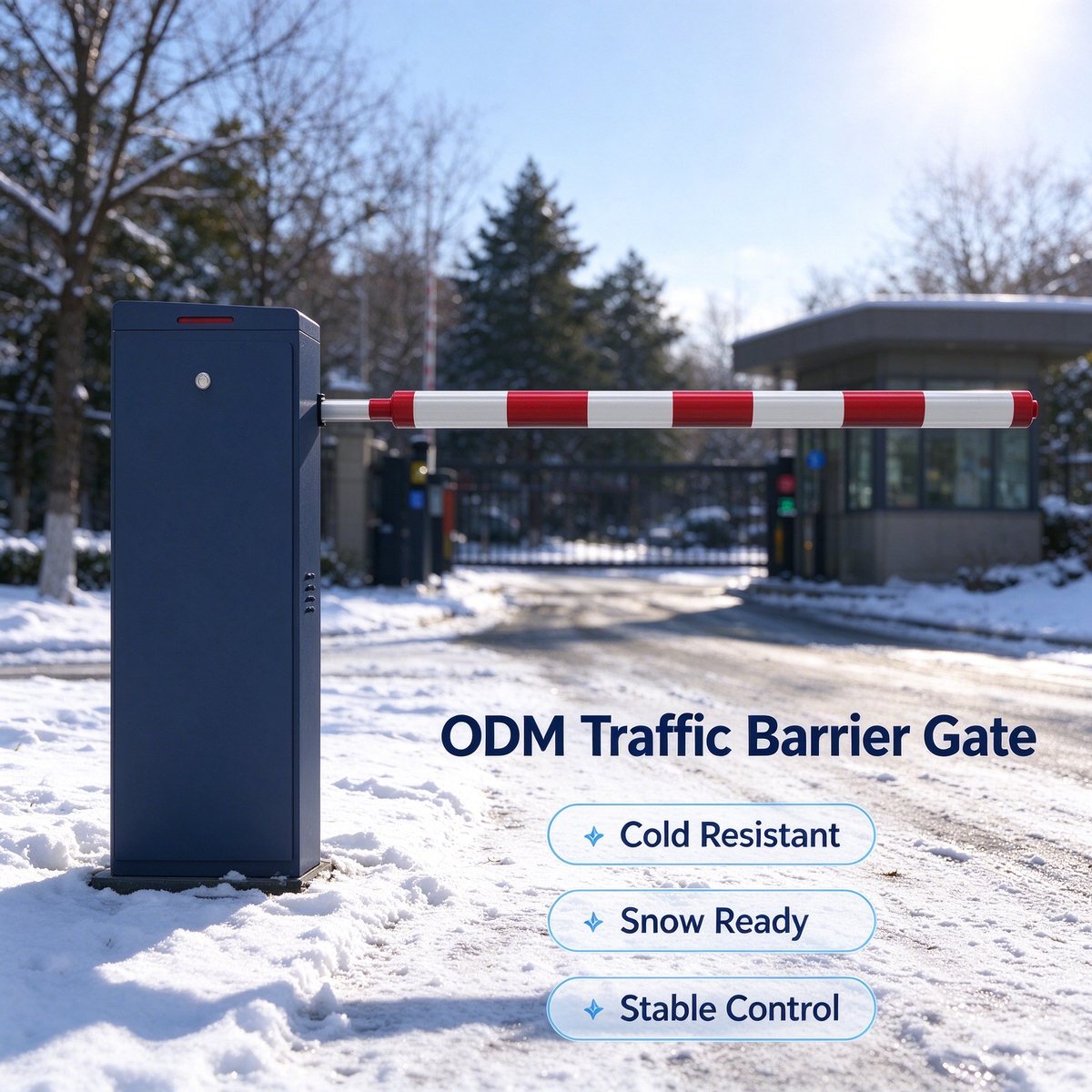
A parking barrier, also known in Mexico as an automatic vehicle barrier or access boom, is a device designed to allow or prevent the passage of vehicles through a lane. It generally includes a housing with a motor and drive mechanism, an arm, a control board, and connections for command and safety devices.
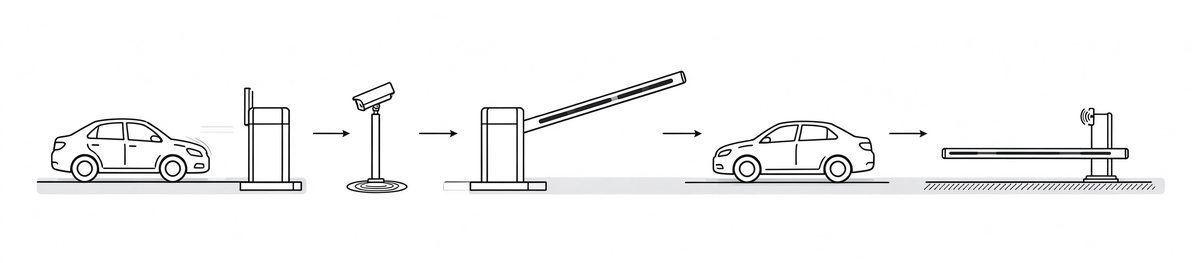
When it receives a valid authorization signal, the system activates the mechanism to raise the arm. Once the vehicle passes and the system confirms that the closing area is clear, the controller begins lowering according to the configuration. The exact behavior depends on the model, the sensors, and the control logic installed.
A vehicle barrier is not the same as a complete parking system. On its own it can control physical passage, while user identification, payment, plate records, and permission management may require additional readers, cameras, and software.
The housing contains the motor, the drive mechanism, and the control components. It must be mounted on a suitable base and in a location that allows the equipment to be operated, inspected, and maintained without obstructing traffic.
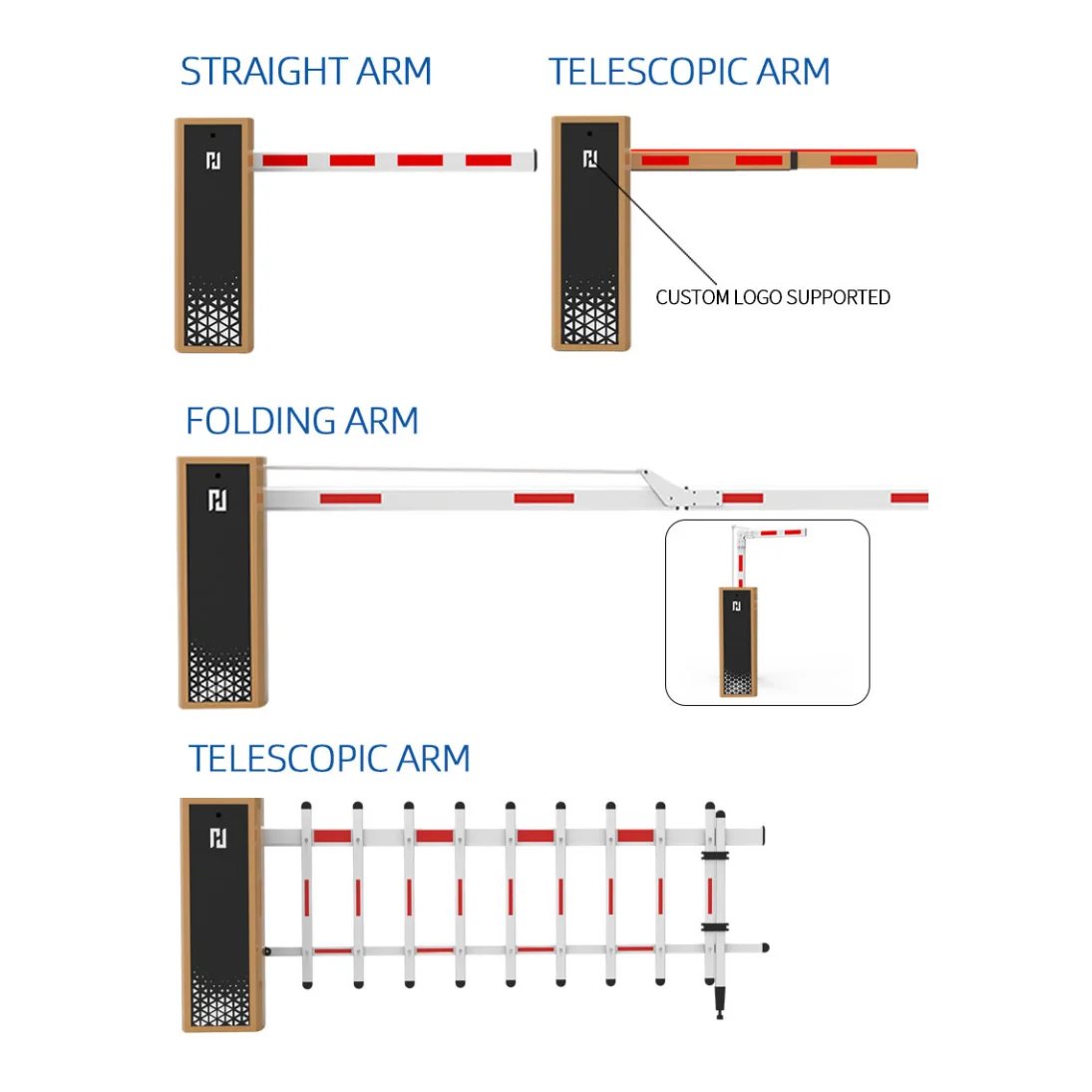
The arm is the visible element that blocks or frees the lane. There may be straight, folding, or other configurations compatible with the equipment. The length and type of arm must correspond to the width of the access point, the clear height, and the environmental conditions of the site.
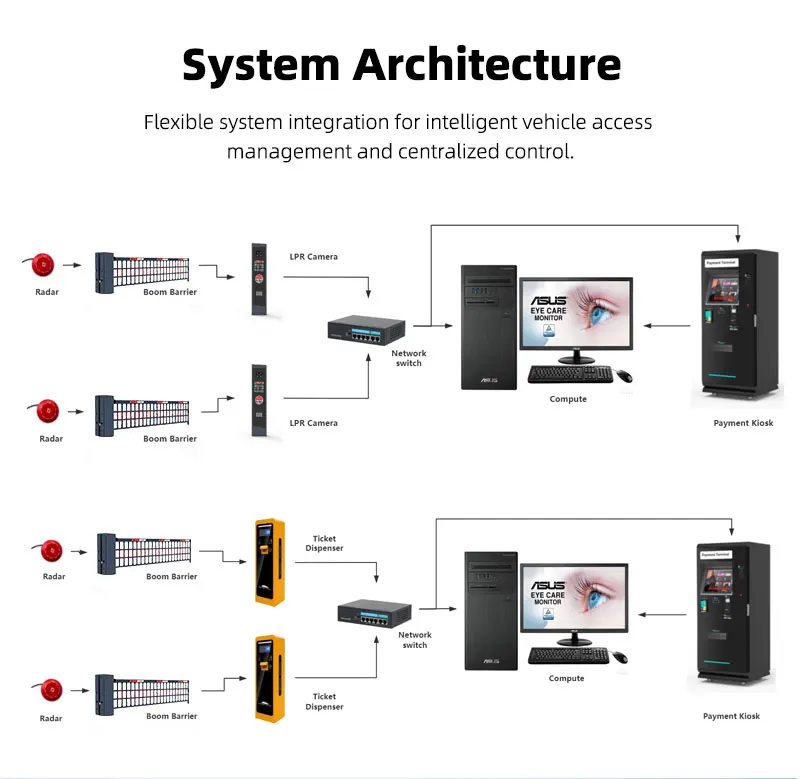
The controller processes the opening signals, manages the operation of the mechanism, and coordinates the inputs from compatible devices. Before integrating external equipment, review the available interfaces, the electrical requirements, and the communication protocol.
Depending on the design, loop detectors, radar sensors, photocells, or other compatible devices may be used to detect vehicles or protect the movement area. The selection and location of the sensors must be based on an assessment of the access point and on the manufacturer's instructions.
The request may come from a remote control, an RFID/UHF card, a ticket, a QR code, a payment station, or an ANPR/LPR license plate recognition camera. The method depends on how the access point is designed and on the authorization rules of the facility.
The system checks the received signal according to the configuration. For example, it can verify whether a card is registered or whether a plate appears on an authorized list. If the integration includes external software, compatibility between the barrier controller and the management platform must be confirmed.
When the authorization is valid, the controller activates the mechanism to raise the arm. The opening speed depends on the model, the length and configuration of the arm, and the equipment settings. To compare products, use the specifications of the exact model and verify the conditions under which the opening time was measured.
Compatible detection devices help determine whether a vehicle is in the passage area. The safety logic must be configured to reduce the risk of the arm descending onto a vehicle. Actual protection depends on the complete design, the installation, the configuration, and the tests performed.
When the vehicle has passed and the area is clear, the controller begins closing according to the established mode. The installation must also consider what to do in the event of a power outage, a communication failure, or an emergency, following the manufacturer's instructions and the site procedures.
The straight-arm barrier is a common option for open-air parking lots, offices, commercial access points, and private entrances where there is enough vertical space for the arm to move. It is important to check the appropriate length and that there are no obstacles in the path.
The folding arm may be appropriate at access points with low ceilings, covered ramps, or nearby structures that limit the clear height. Before choosing it, verify the opening geometry and the compatibility of the arm with the mechanism of the model.
High-speed barriers can be useful at access points where operating frequency and waiting time are important factors. The decision must consider vehicle flow, arm length, duty cycles, and the detection system. A high rated speed does not by itself guarantee that queues will disappear.
A barrier can be connected to RFID/UHF readers to recognize credentials, or to ANPR/LPR cameras to identify plates. These integrations can speed up access for authorized users, provided that the hardware, the software, and the operating rules are compatible and correctly configured.
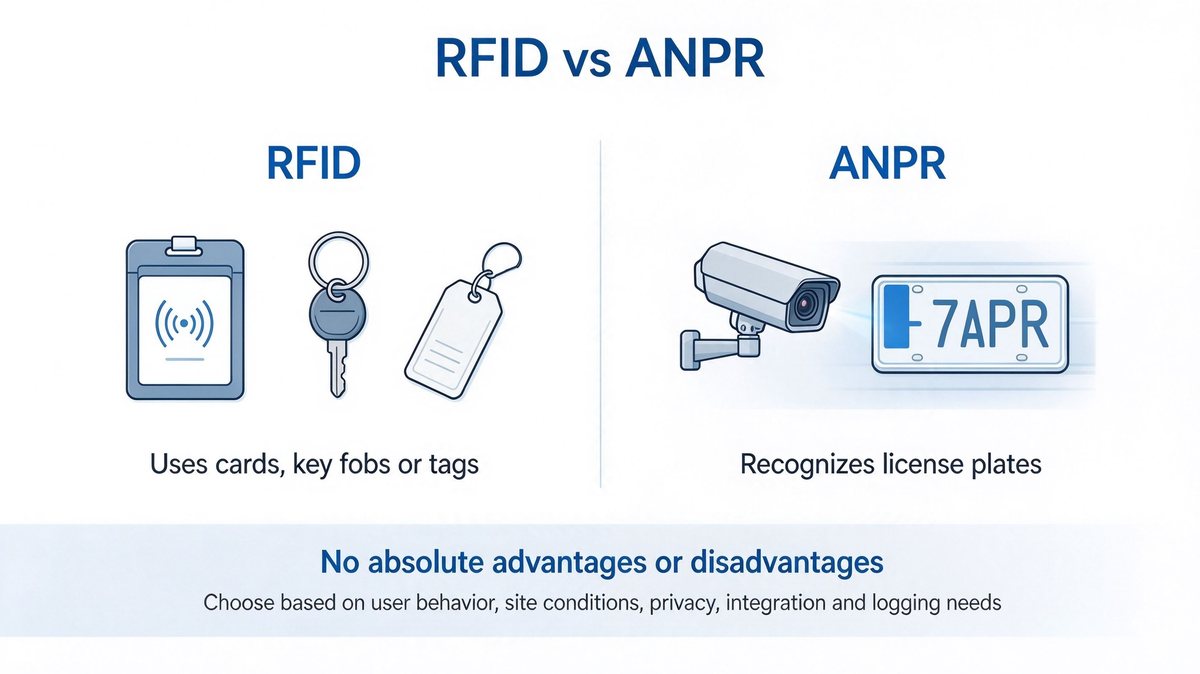
Each environment requires a different configuration. A parking lot with visitors may need tickets or QR codes, while an industrial access point may require credentials, plate identification, and specific procedures for cargo vehicles. Define the operating process before deciding on the equipment.
First, measure the lane width, the clear height, and the installation space. Then estimate the number of vehicles per hour, the cycle frequency, and the vehicle type. With this data, the supplier can evaluate the most appropriate arm, mechanism, and configuration for the access point.
Confirm the power supply of the exact model. For an installation in Mexico, ask about the 127 V / 60 Hz configuration when applicable, and verify the datasheet, the grounding, and the site conditions with a qualified installer. Do not assume that all models have the same electrical configuration.
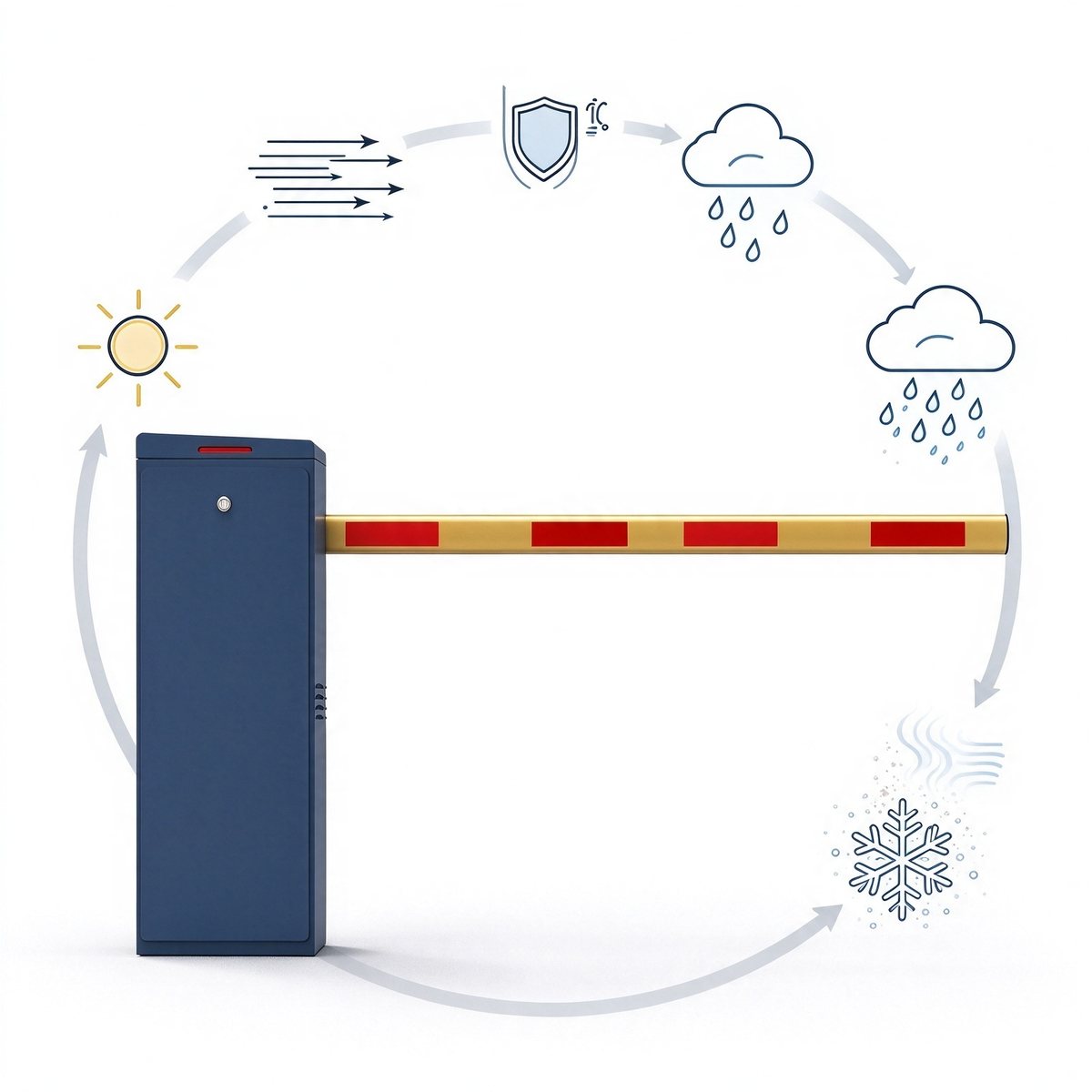
Also review the environment: rain, dust, heat, humidity, wind, and possible impacts. Request the environmental protection data and the operating conditions stated for the quoted model. If the installation is outdoor or industrial, specify these conditions before closing the purchase.
Finally, define the required integration, the maintenance requirements, spare parts availability, the warranty, and technical support in Spanish. Compare quotes using the same list of components to avoid hidden differences in the scope of supply.
BAROXON presents solutions related to vehicle barriers, high-speed barriers, ANPR/LPR license plate recognition, RFID access, radar sensors and vehicle detectors, as well as accessories depending on the available range. The appropriate combination depends on the project; that is why it is important to verify the features of the specific model and the components included in the proposal.
Before buying, request a datasheet and confirm in writing the arm length, the operating time, the interfaces, the compatible sensors, the power supply, the warranty, and the availability of spare parts. If the project includes cameras or third-party software, also request validation of compatibility.
Yes. It can be operated with a remote control, a button, RFID, or another compatible method. License plate recognition is an integration option, not a universal requirement for all installations.
The barrier physically controls the passage of the vehicle. Access control determines who can pass and under what conditions. When they are integrated, the authorization system can send a command to the barrier after validating a credential, a plate, or another permitted signal.
Protection depends on the safety design, the compatible sensors, their location, and correct configuration and testing. Ask the installer to document the detection functions, the test procedures, and the measures for operating in the event of a failure.
Maintenance depends on the model and the conditions of use. The arm and its fastenings, the mechanism, the housing, the wiring, and the safety devices are normally inspected. Follow the manufacturer's manual and use trained personnel for adjustments.
Request the model datasheet, the installation and connection diagrams, the included components, the electrical configuration, the warranty, the maintenance instructions, and confirmation of compatibility with external systems.
An automatic vehicle barrier controls physical access through a motorized arm and can be integrated with readers, cameras, and sensors to meet the needs of each installation. To choose correctly in Mexico, evaluate the dimensions, the vehicle flow, the arm type, the authorization, the safety, the power supply, and the maintenance. A clear specification and a well-tested installation help improve operation and reduce risks at the access point.


